Latest Blogs




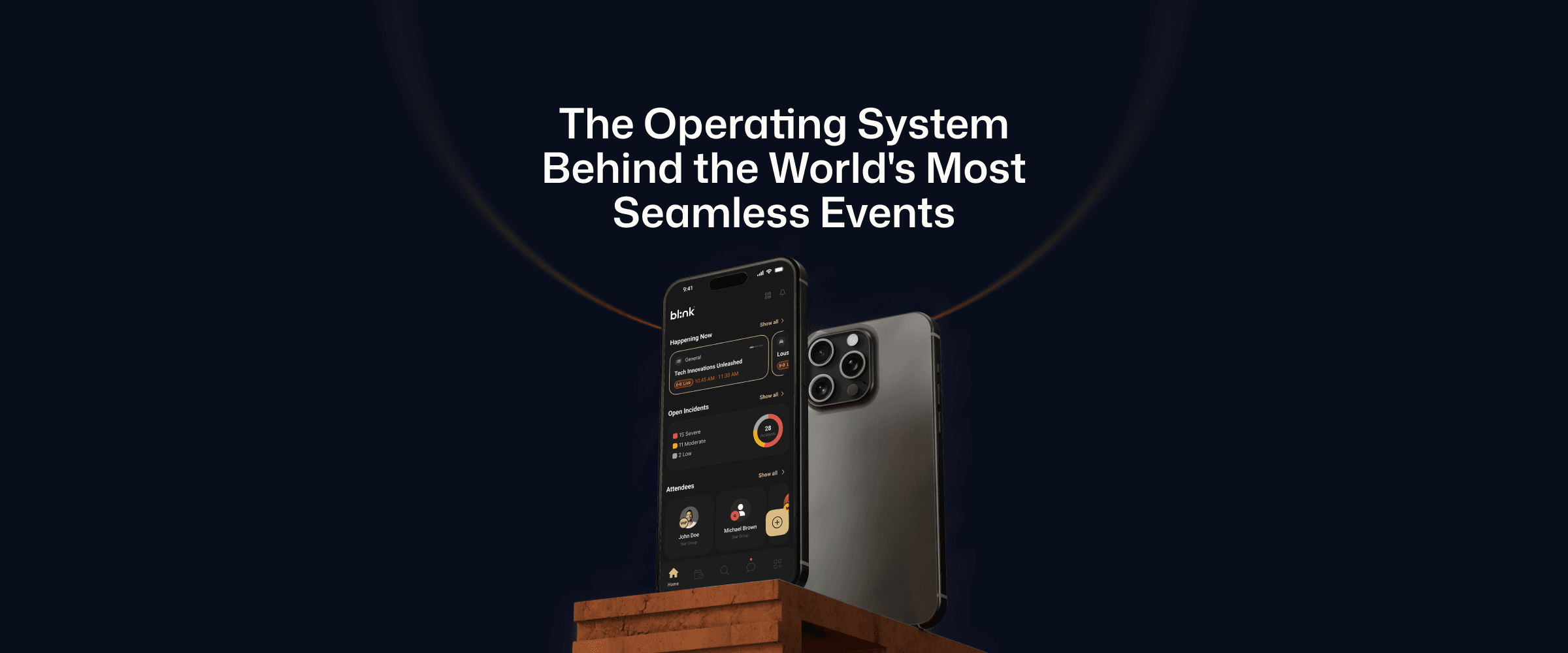
Blink ExperienceOS: The Operating System Behind the World's Most High-Stakes Events
Most event teams aren't short on tools. They have a registration platform, a credential system, a transport tracker, a communications app, and a reporting dashboard. They have everything, except the one thing that connects it all.
That disconnection is not a minor inconvenience. It is the root cause of almost every operational failure in modern event management. And it is exactly the problem Blink ExperienceOS was built to solve.
The Problem With Building on Fragments
Event teams know this feeling intimately:
A guest credential verified in one system that doesn't communicate with the entry gate
A transport update that reaches the operations team too late to act on
A hospitality suite that has no visibility into who is arriving and when
A post-event report assembled manually from five different platforms
Each gap is a moment where the experience fractures. And guests, even when they can't name the failure, feel every one of them.
What an Operating System Actually Does
An operating system doesn't perform tasks. It creates the conditions for every task to perform better. It connects, synchronises, and orchestrates, turning independent components into a single, intelligent whole.
This is the distinction that defines Blink ExperienceOS.
Disconnected Tools | Blink ExperienceOS |
Each system holds its own data | One unified data layer across all modules |
Teams manually sync information | Real-time synchronisation across every touchpoint |
Visibility is retrospective | Live operational intelligence at every layer |
Guest experience is assembled | Guest experience is orchestrated |
Problems are managed after they occur | Issues are surfaced and resolved before guests feel them |
The shift is not incremental. It is architectural.
Intelligence That Works Beneath the Surface
The most important thing about Blink ExperienceOS is what guests never see.
They don't see the predictive monitoring that flags a potential bottleneck at Gate C twenty minutes before it forms. They don't see the live sync that updates every team's dashboard as soon as a VIP's flight lands early. They don't see the credential layer that already knows who is arriving before they reach the door.
What guests experience instead is something far simpler: an event that just works.
The goal of orchestration is invisibility. When the infrastructure disappears, the experience begins.
Built for Scale and Complexity
Blink ExperienceOS was not designed only for simple events. It was designed for moments when scale, complexity, and global visibility converge, and when the margin for error is zero.
The events industry has spent years adding tools to solve problems that tools alone cannot fix. Blink ExperienceOS offers something different, not another layer on top of the stack, but the foundation beneath it.
One system. Every layer. Orchestrated.




" height="36.999998935290364px" id="U8lSvJQnz" width="76.99999479379187px"/></svg>)
" height="35.946300804560565px" id="JOXlSIPVT" width="140.9905775924913px"/></svg>)