|
Event Management
Why Great Events Break When Their Systems Don’t Talk to Each Other
Why Great Events Break When Their Systems Don’t Talk to Each Other
Why Great Events Break When Their Systems Don’t Talk to Each Other
|
Event Management

When registration, access, schedules, support, and live operations run in silos, friction is inevitable. Discover why great events often break behind the scenes, and what it takes to keep the full experience aligned.
When registration, access, schedules, support, and live operations run in silos, friction is inevitable. Discover why great events often break behind the scenes, and what it takes to keep the full experience aligned.
Latest Blogs
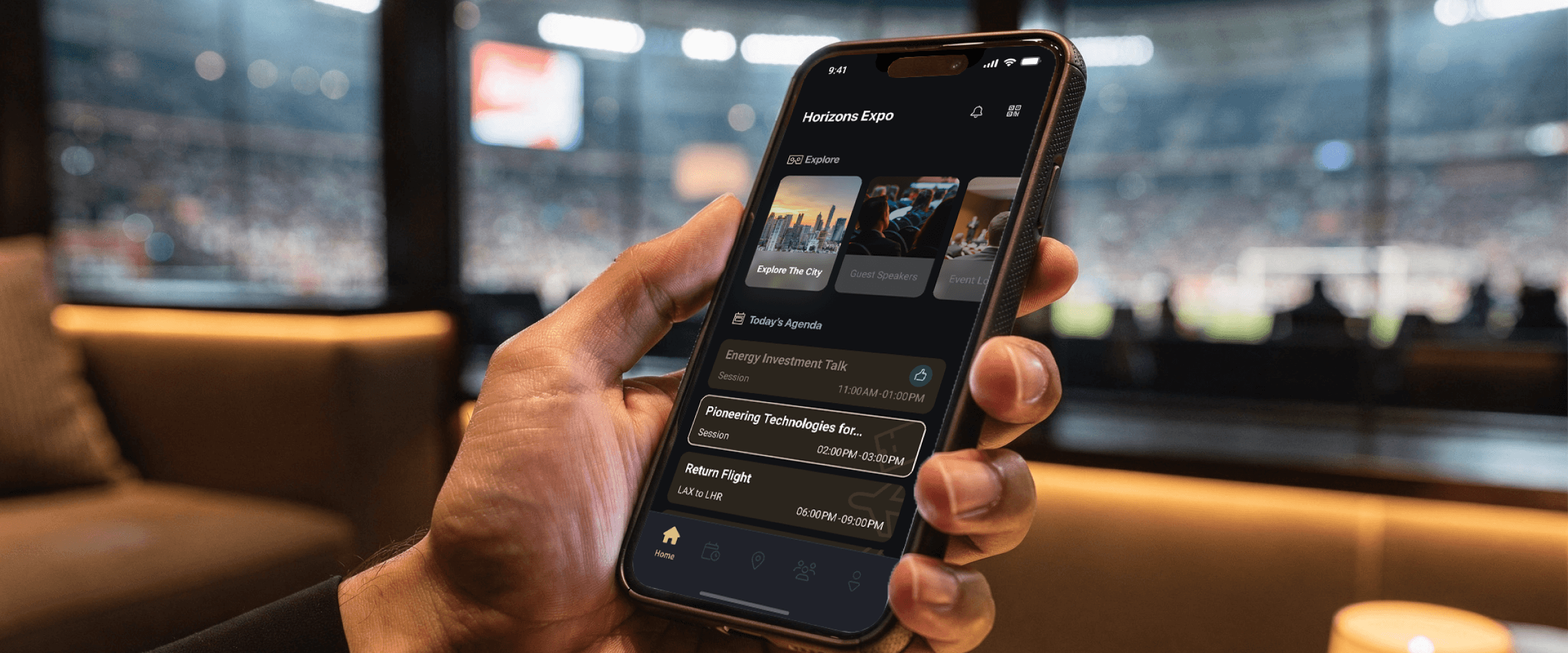


A guest is delayed at check-in. A VIP arrives, but the latest access rules are missing. A session update goes live in one system, while staff are still working from another. Support is trying to solve an issue without the full attendee context, and operations are relying on last-minute messages to close the gap. On the surface, these moments can look isolated. In reality, they usually point to a deeper problem: the event’s systems are not working together. This is where many otherwise well-planned events begin to break.
Event teams today are not short on tools. Most have platforms for registration, agenda management, badging, communication, guest support, networking, transport coordination, and reporting. The issue is not whether those tools exist. It is whether they are aligned closely enough to support a single, continuous event experience. When they are not, teams compensate manually. They cross-check lists, resend updates, clarify access rules, patch data inconsistencies, and rely on internal workarounds to keep the experience intact. For a while, that effort can hide the cracks. But under live event pressure, fragmentation becomes visible.
The problem is rarely one failed tool
When people think about event disruption, they often imagine obvious causes: poor planning, delayed approvals, staffing issues, or last-minute changes. Those things matter. But many guest-facing problems are not caused by a single dramatic failure. They emerge from small disconnects between systems that were never designed to act as one operating environment.
A registration update may not carry through to access permissions. A guest profile may exist in multiple versions across platforms. Badge logic may not reflect the latest attendee category. Agenda changes may reach the app, but not the staff managing entry or support. Transport teams may be coordinating movement without visibility into schedule shifts or guest status.
None of these gaps looks catastrophic on its own. Together, they create operational drag. More importantly, they create inconsistency, and inconsistency is what attendees feel. In modern events, the quality of the experience depends on backstage continuity. A guest may only experience one moment of friction, but that moment often begins much earlier in the operational chain.
What disconnected systems look like in real event environments
Disconnected systems do not always announce themselves as a technology problem. They usually show up as manual work. Teams are forced to reconcile attendee records across multiple sources. Changes are repeated by hand. Internal channels become the place where the real event is managed, because the systems themselves are not carrying the latest truth. Staff begin relying on memory, screenshots, spreadsheets, private notes, and message threads to move the event forward.
This is especially risky in enterprise, VIP, and high-complexity environments, where access rules are layered, attendee movement matters, and every handoff affects perception. Consider a familiar pattern. Registration is handled in one place. Access permissions are configured somewhere else. Personalized schedules live in the attendee app. Guest preferences sit with a concierge or hospitality team. Support requests come through another interface. Transport updates are managed externally. Reporting is assembled later from several sources. Each piece may work well in isolation, but isolation is exactly the problem.Events are not experienced in isolation. They are lived as one journey.
That means attendee identity, schedule visibility, credential rules, support context, and live operational updates need to stay connected across moments. When they do not, teams spend more time translating between systems than acting with confidence inside them.
Where friction becomes visible across the attendee journey
Fragmentation rarely stays backstage. Eventually, it reaches the guest. Before arrival, it may begin with something simple: a profile update that never reaches the right team, a preference that gets lost between onboarding and hospitality, or a communication that reflects outdated event details. These are early signs that registration and onboarding are not truly connected to the rest of the experience.
At arrival, the gap becomes harder to hide. Check-in and badge workflows rely on accurate identity, current attendee status, and clear credential logic. If access permissions are not aligned to the latest registration reality, the issue lands at the front desk. That creates delay for the guest and pressure for staff, even when the problem should have been resolved upstream.
Inside the event, the impact widens. Personalized agendas and content only work when updates are synchronized. If sessions move, capacity changes, or access conditions shift, every related touchpoint needs to reflect the same version of the event. Otherwise, guests receive mixed signals, and staff are left correcting confusion in real time.
Networking is affected too. AI-powered matchmaking and connection discovery depend on profile quality, audience logic, and event objectives being structured and current. When attendee identity is fragmented, networking becomes generic instead of relevant. The result is often a feature that exists, but does not create the value it should.
Support suffers in similar ways. A guest issue is easier to resolve when support and communication systems have visibility into who the attendee is, where they should be, what access they hold, what schedule they are following, and what changes may have affected them. Without that context, response becomes reactive and slower than it needs to be.
In high-touch environments, transport and movement coordination raise the stakes further. A single guest journey may depend on timing, role, location, schedule, and access. If transport planning is disconnected from the rest of the event operation, precision becomes difficult to sustain. Each of these breakdowns feels different on the surface. Structurally, they come from the same place: the event does not have a shared operational truth.
The real cost of fragmented event operations
It is easy to describe disconnected systems as inefficient. That is true, but it is not enough.The deeper cost is loss of control. When teams are forced to bridge gaps manually, speed drops. Confidence drops. Decision-making becomes slower because information is incomplete or inconsistent. Leadership visibility weakens because reporting is assembled after the fact rather than understood during the event. Personalization suffers because the data needed to support it is scattered. Sponsors and partners receive less value because the experience becomes harder to measure and shape in real time.
There is also a human cost. Operational teams end up carrying hidden complexity that technology should be handling for them. They become the connectors between systems, the interpreters between departments, and the safety net for every gap in the workflow. That effort is rarely visible from the outside, but it determines whether the event feels controlled or fragile.
For attendees, the effect is simpler. The event either feels well run or it does not. They do not care which platform failed to sync. They care that access was unclear, support lacked answers, their schedule felt inconsistent, or an expected interaction did not happen smoothly. This is why operational fragmentation is not just a back-office issue. It is an experience issue. It is a trust issue. In some environments, it is also a brand issue.
Why orchestration matters more than integration alone
The industry often responds to these challenges with a familiar idea: integration. And integration does matter. But in live event environments, connection alone is not the full answer.An event does not simply need systems that exchange data. It needs systems that support coordinated action.That is the difference between fragmented tooling and orchestration.
Orchestration means registration, identity, access, content, networking, support, transport, and operations are not just technically linked. They are aligned around the same event logic. Updates carry through the environment in ways that help teams act faster and with more clarity. Attendee identity remains consistent. Operational teams work from shared visibility. The experience reflects one connected reality rather than a collection of separate workflows. This is where Blink ExperienceOS fits differently.
Blink is not just another event app or a disconnected management tool added to the stack. It is an experience orchestration system designed to unify the moving parts that define modern events. That includes registration and onboarding, attendee identity and profile continuity, personalized agendas and content, secure access and credential logic, check-in and badge workflows, AI-powered matchmaking, support and guest communication, transport and movement coordination, organizer operations, and unified reporting across the event journey. The value of that model is not that each function exists. The value is that they work together in context.
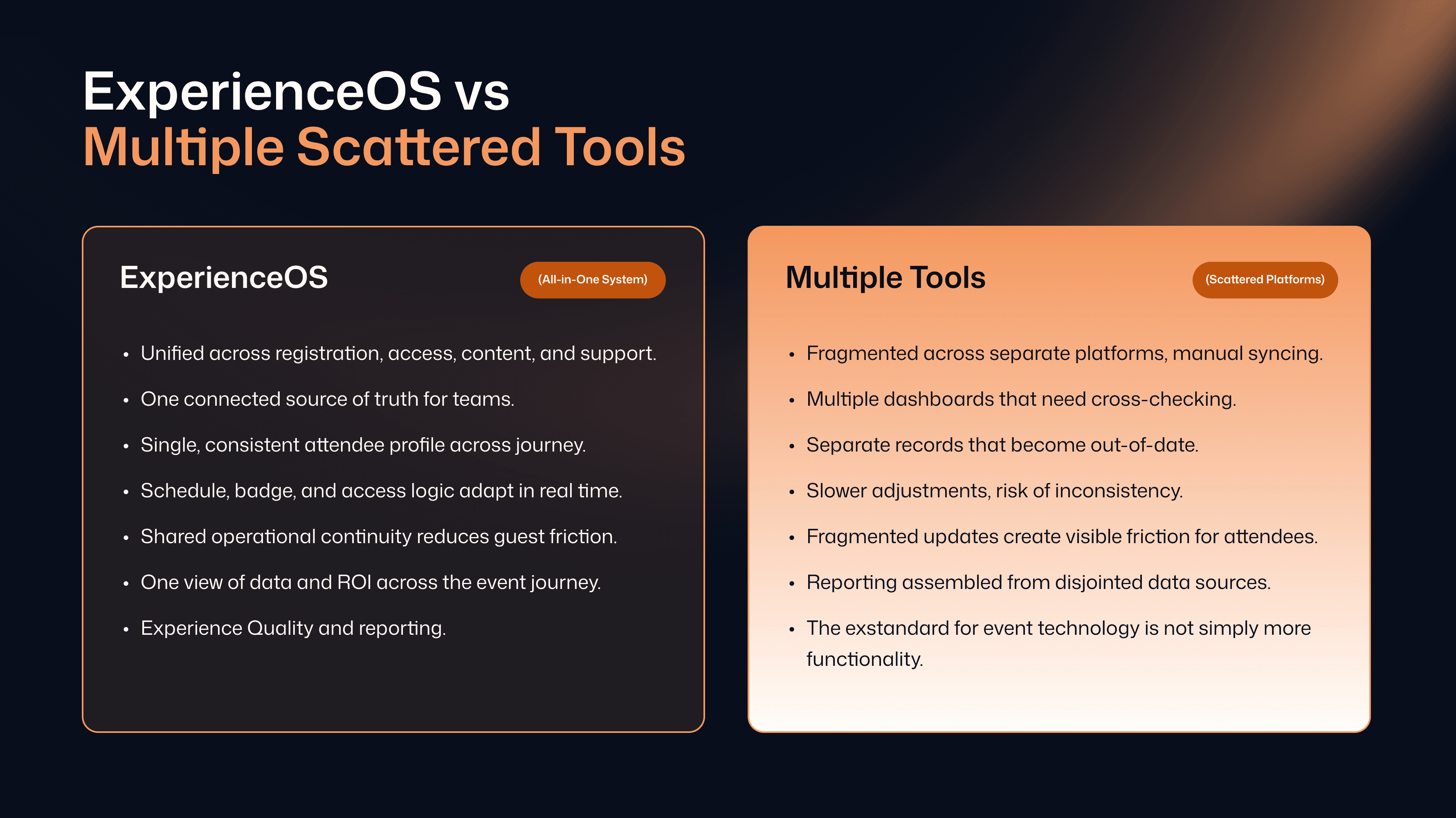
What a connected event environment looks like
In a connected event environment, attendee identity remains coherent from the first interaction through arrival, participation, and follow-up. Registration and onboarding do not end at sign-up. They feed the rest of the event system with reliable context. Access permissions reflect real attendee status. Badge workflows align with the latest rules. Personalized content and schedules respond to live changes more gracefully. Support teams are better informed because they are not working in isolation from the event itself.
Networking becomes more useful because it is built on stronger profile continuity and more relevant event intelligence. Organizer operations improve because teams can see more of the same picture at the same time. Reporting becomes more meaningful because the event is not being reconstructed from disconnected datasets after it ends.
Most importantly, the event feels calmer. Not because complexity disappears, but because complexity is managed through a connected operating layer rather than absorbed by people through manual intervention. That is what stronger orchestration creates. Less reconciliation. Better continuity. Faster action. A more controlled experience for teams and a more confident one for guests.
The future of event quality is operational continuity
As events become more personalized, high-touch, and data-driven, fragmentation becomes harder to hide. Great event experiences cannot rely on workarounds or disconnected tools. They depend on operational continuity across registration, access, content, networking, support, logistics, and live operations. The next standard in event technology is not simply more functionality, but a connected environment that keeps the full event journey aligned. That is the shift from tooling to orchestration, and where Blink ExperienceOS is built to operate.
A guest is delayed at check-in. A VIP arrives, but the latest access rules are missing. A session update goes live in one system, while staff are still working from another. Support is trying to solve an issue without the full attendee context, and operations are relying on last-minute messages to close the gap. On the surface, these moments can look isolated. In reality, they usually point to a deeper problem: the event’s systems are not working together. This is where many otherwise well-planned events begin to break.
Event teams today are not short on tools. Most have platforms for registration, agenda management, badging, communication, guest support, networking, transport coordination, and reporting. The issue is not whether those tools exist. It is whether they are aligned closely enough to support a single, continuous event experience. When they are not, teams compensate manually. They cross-check lists, resend updates, clarify access rules, patch data inconsistencies, and rely on internal workarounds to keep the experience intact. For a while, that effort can hide the cracks. But under live event pressure, fragmentation becomes visible.
The problem is rarely one failed tool
When people think about event disruption, they often imagine obvious causes: poor planning, delayed approvals, staffing issues, or last-minute changes. Those things matter. But many guest-facing problems are not caused by a single dramatic failure. They emerge from small disconnects between systems that were never designed to act as one operating environment.
A registration update may not carry through to access permissions. A guest profile may exist in multiple versions across platforms. Badge logic may not reflect the latest attendee category. Agenda changes may reach the app, but not the staff managing entry or support. Transport teams may be coordinating movement without visibility into schedule shifts or guest status.
None of these gaps looks catastrophic on its own. Together, they create operational drag. More importantly, they create inconsistency, and inconsistency is what attendees feel. In modern events, the quality of the experience depends on backstage continuity. A guest may only experience one moment of friction, but that moment often begins much earlier in the operational chain.
What disconnected systems look like in real event environments
Disconnected systems do not always announce themselves as a technology problem. They usually show up as manual work. Teams are forced to reconcile attendee records across multiple sources. Changes are repeated by hand. Internal channels become the place where the real event is managed, because the systems themselves are not carrying the latest truth. Staff begin relying on memory, screenshots, spreadsheets, private notes, and message threads to move the event forward.
This is especially risky in enterprise, VIP, and high-complexity environments, where access rules are layered, attendee movement matters, and every handoff affects perception. Consider a familiar pattern. Registration is handled in one place. Access permissions are configured somewhere else. Personalized schedules live in the attendee app. Guest preferences sit with a concierge or hospitality team. Support requests come through another interface. Transport updates are managed externally. Reporting is assembled later from several sources. Each piece may work well in isolation, but isolation is exactly the problem.Events are not experienced in isolation. They are lived as one journey.
That means attendee identity, schedule visibility, credential rules, support context, and live operational updates need to stay connected across moments. When they do not, teams spend more time translating between systems than acting with confidence inside them.
Where friction becomes visible across the attendee journey
Fragmentation rarely stays backstage. Eventually, it reaches the guest. Before arrival, it may begin with something simple: a profile update that never reaches the right team, a preference that gets lost between onboarding and hospitality, or a communication that reflects outdated event details. These are early signs that registration and onboarding are not truly connected to the rest of the experience.
At arrival, the gap becomes harder to hide. Check-in and badge workflows rely on accurate identity, current attendee status, and clear credential logic. If access permissions are not aligned to the latest registration reality, the issue lands at the front desk. That creates delay for the guest and pressure for staff, even when the problem should have been resolved upstream.
Inside the event, the impact widens. Personalized agendas and content only work when updates are synchronized. If sessions move, capacity changes, or access conditions shift, every related touchpoint needs to reflect the same version of the event. Otherwise, guests receive mixed signals, and staff are left correcting confusion in real time.
Networking is affected too. AI-powered matchmaking and connection discovery depend on profile quality, audience logic, and event objectives being structured and current. When attendee identity is fragmented, networking becomes generic instead of relevant. The result is often a feature that exists, but does not create the value it should.
Support suffers in similar ways. A guest issue is easier to resolve when support and communication systems have visibility into who the attendee is, where they should be, what access they hold, what schedule they are following, and what changes may have affected them. Without that context, response becomes reactive and slower than it needs to be.
In high-touch environments, transport and movement coordination raise the stakes further. A single guest journey may depend on timing, role, location, schedule, and access. If transport planning is disconnected from the rest of the event operation, precision becomes difficult to sustain. Each of these breakdowns feels different on the surface. Structurally, they come from the same place: the event does not have a shared operational truth.
The real cost of fragmented event operations
It is easy to describe disconnected systems as inefficient. That is true, but it is not enough.The deeper cost is loss of control. When teams are forced to bridge gaps manually, speed drops. Confidence drops. Decision-making becomes slower because information is incomplete or inconsistent. Leadership visibility weakens because reporting is assembled after the fact rather than understood during the event. Personalization suffers because the data needed to support it is scattered. Sponsors and partners receive less value because the experience becomes harder to measure and shape in real time.
There is also a human cost. Operational teams end up carrying hidden complexity that technology should be handling for them. They become the connectors between systems, the interpreters between departments, and the safety net for every gap in the workflow. That effort is rarely visible from the outside, but it determines whether the event feels controlled or fragile.
For attendees, the effect is simpler. The event either feels well run or it does not. They do not care which platform failed to sync. They care that access was unclear, support lacked answers, their schedule felt inconsistent, or an expected interaction did not happen smoothly. This is why operational fragmentation is not just a back-office issue. It is an experience issue. It is a trust issue. In some environments, it is also a brand issue.
Why orchestration matters more than integration alone
The industry often responds to these challenges with a familiar idea: integration. And integration does matter. But in live event environments, connection alone is not the full answer.An event does not simply need systems that exchange data. It needs systems that support coordinated action.That is the difference between fragmented tooling and orchestration.
Orchestration means registration, identity, access, content, networking, support, transport, and operations are not just technically linked. They are aligned around the same event logic. Updates carry through the environment in ways that help teams act faster and with more clarity. Attendee identity remains consistent. Operational teams work from shared visibility. The experience reflects one connected reality rather than a collection of separate workflows. This is where Blink ExperienceOS fits differently.
Blink is not just another event app or a disconnected management tool added to the stack. It is an experience orchestration system designed to unify the moving parts that define modern events. That includes registration and onboarding, attendee identity and profile continuity, personalized agendas and content, secure access and credential logic, check-in and badge workflows, AI-powered matchmaking, support and guest communication, transport and movement coordination, organizer operations, and unified reporting across the event journey. The value of that model is not that each function exists. The value is that they work together in context.
What a connected event environment looks like
In a connected event environment, attendee identity remains coherent from the first interaction through arrival, participation, and follow-up. Registration and onboarding do not end at sign-up. They feed the rest of the event system with reliable context. Access permissions reflect real attendee status. Badge workflows align with the latest rules. Personalized content and schedules respond to live changes more gracefully. Support teams are better informed because they are not working in isolation from the event itself.
Networking becomes more useful because it is built on stronger profile continuity and more relevant event intelligence. Organizer operations improve because teams can see more of the same picture at the same time. Reporting becomes more meaningful because the event is not being reconstructed from disconnected datasets after it ends.
Most importantly, the event feels calmer. Not because complexity disappears, but because complexity is managed through a connected operating layer rather than absorbed by people through manual intervention. That is what stronger orchestration creates. Less reconciliation. Better continuity. Faster action. A more controlled experience for teams and a more confident one for guests.
The future of event quality is operational continuity
As events become more personalized, high-touch, and data-driven, fragmentation becomes harder to hide. Great event experiences cannot rely on workarounds or disconnected tools. They depend on operational continuity across registration, access, content, networking, support, logistics, and live operations. The next standard in event technology is not simply more functionality, but a connected environment that keeps the full event journey aligned. That is the shift from tooling to orchestration, and where Blink ExperienceOS is built to operate.


Experience what's
next with Blink
Experience what's
next with Blink
Experience what's
next with Blink
Join our community and stay ahead with exclusive news and updates.
Experience what's
next with Blink
Join our community and stay ahead with exclusive news and updates.
Orchestrate Limitless
Experiences, Effortlessly.
It’s one thing to talk about Blink…another to see it in action.
Orchestrate Limitless
Experiences, Effortlessly.
It’s one thing to talk about Blink…another to see it in action.
Orchestrate Limitless
Experiences, Effortlessly.
It’s one thing to talk about Blink…another to see it in action.
Orchestrate Limitless
Experiences, Effortlessly.
It’s one thing to talk about Blink
another to see it in action.
Trusted by
" height="36.999998935290364px" id="U8lSvJQnz" width="76.99999479379187px"/></svg>)
" height="35.946300804560565px" id="JOXlSIPVT" width="140.9905775924913px"/></svg>)


Trusted by
Trusted by
Get an AI summary of Blink

Exclusive Partnership


Get an AI summary of Blink
Exclusive Partnership
Get an AI summary of Blink
Exclusive Partnership
Get an AI summary of Blink
Exclusive Partnership